


 Windy
Windy
 WeChat
 WhatsApp
Windy
WeChat
WhatsApp
Click:7 seen
The axe is an indispensable core tool in outdoor camping, wilderness exploration, and forest work. Unlike household axes, outdoor axes place greater emphasis on portability, durability, build quality, and suitability for specific scenarios. Whether for chopping firewood during camping, clearing debris, building shelters, or for emergency survival and wildwood logging, a suitable outdoor axe can significantly enhance the efficiency of outdoor operations. The performance core of an outdoor axe is determined by the axe body material and the handle material. Different materials result in distinct tool characteristics, which are tailored to various outdoor scenarios. Additionally, it is divided into multiple specialized categories to meet the full range of demands from lightweight leisure to professional outdoor work.
Ⅰ. Core Materials and Characteristics of Outdoor Axes
The overall quality of an outdoor axe is determined by both the axe body blade material and the handle material. The blade material controls sharpness, hardness, and shock resistance, while the handle material affects grip feel, shock absorption, and portability. The combination of these two is the key to selection.
(1)Axe Body Blade Material: Determining the Core Performance
The axe body is the core of the operation, and the hardness, toughness, and rust resistance of the material directly determine the lifespan and user experience of the axe. The mainstream materials fall into three categories, suitable for different outdoor needs:
1. High-carbon steel material
This is the most commonly used material for professional outdoor axes. It has a high carbon content and undergoes quenching treatment, resulting in extremely high hardness, excellent sharpness, and good retention. It is not prone to chipping or becoming dull after prolonged use in heavy wood chopping and splitting. It can easily handle hard wood cutting and rough wood splitting, and has excellent cost-effectiveness. However, its rust resistance is poor. When used in outdoor humid environments without timely cleaning and maintenance, it is prone to rust. It is suitable for frequent high-intensity outdoor operations and outdoor enthusiasts who are willing to maintain it daily. It is also the mainstream material for forestry axes and survival axes.
2. Stainless steel material
The greatest advantage of stainless steel axes is its outstanding corrosion resistance and rust prevention ability. It is not affected by outdoor rain, snow, dampness, or muddy conditions, and requires little deliberate maintenance. The material has good toughness and is not prone to fracture, providing high safety. It is suitable for lightweight outdoor scenarios such as camping hand axes, garden cleaning axes, and emergency fire axes. However, its overall hardness is lower than high-carbon steel, resulting in average sharpness and difficulty in handling hard wood during heavy chopping. It is not suitable for heavy logging operations. It is mostly used in low-intensity, high-humidity scenarios such as camping light hand axes, garden cleaning axes, and emergency fire axes.
3. Alloy steel
This is a high-end material for outdoor axes. It is made by adding chromium, molybdenum, vanadium, etc. to carbon steel, balancing high hardness, high sharpness, and rust resistance of stainless steel, while also having better toughness and impact resistance and shock absorption. It performs exceptionally well in extreme outdoor conditions and has excellent stability. It can handle various complex scenarios such as hard wood chopping, fine cutting, and wilderness survival. Its comprehensive performance is top-notch. The only drawback is its higher price, which is mainly used for professional survival axes, high-end camping axes, and specialized axes for outdoor exploration.
(2)Handle Material: Determining Grip Experience and Durability
The handle directly affects the operation feel, shock absorption, and portability. High-quality handle materials can effectively buffer the impact force during chopping, reducing hand fatigue and vibration. The mainstream types include wooden, synthetic, and all-steel integrated three types:
1. Wooden Handle (Hickory wood, Beech wood, Ash wood)
This is the traditional high-quality outdoor axe handle material. North American hickory wood is the industry's preferred choice. It has high density, tight texture, and excellent shock absorption properties. It can significantly buffer the impact force during chopping, providing a warm and comfortable grip feel that is not prone to slipping. The force transmission is smooth. Beech wood and ash wood are more cost-effective, with lightweight texture, suitable for regular outdoor scenarios. The disadvantage of wooden handles is that they are susceptible to sun exposure and water soaking. Long-term use in harsh environments can cause cracking and deformation, requiring regular application of wood wax oil for maintenance. They are mostly used in mid-to-high-end camping axes and handmade outdoor axes.
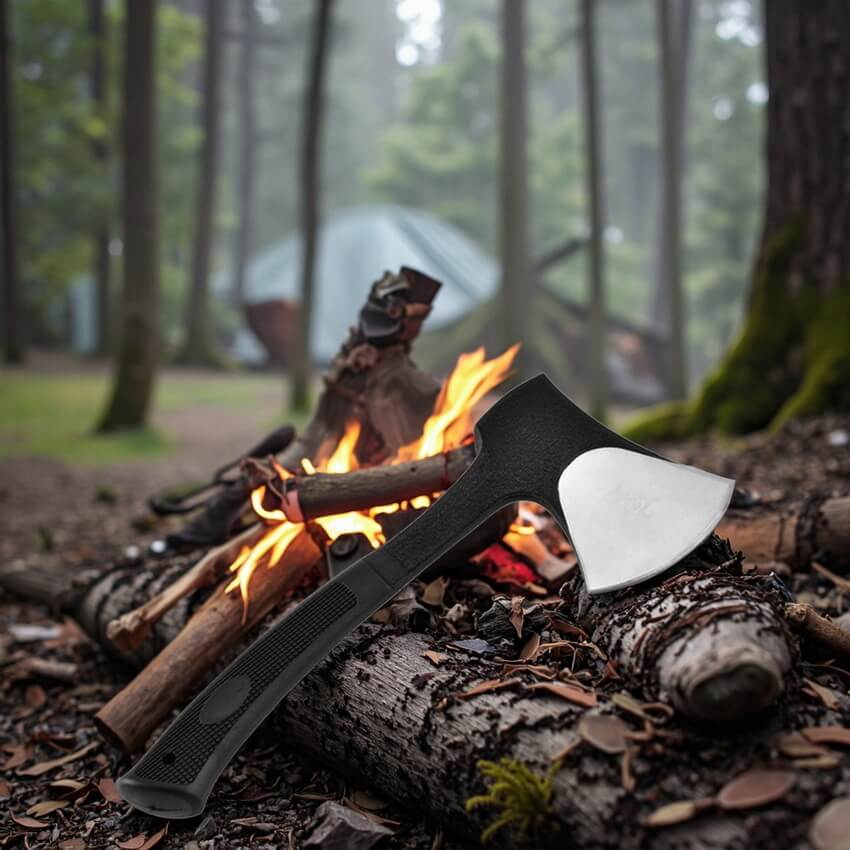
2. Synthetic Handle (Glass fiber, nylon composite material) Currently, the mainstream handle material for popular outdoor axes is waterproof, resistant to sun exposure, and corrosion-resistant. They can withstand harsh outdoor conditions and rarely deform or crack, requiring no maintenance and being extremely durable. The material is lightweight, strong, and has superior impact resistance compared to ordinary wood. The price is also affordable. The handles are often designed with anti-slip textures and ergonomic features, providing a stable grip. The drawback is that the shock absorption is slightly poor, and the hand feels vibrations more when performing heavy chopping or striking. They are suitable for beginners, casual camping, and light outdoor activities.
3. All-Steel Integrated Handle
The axe body and handle are forged as a single piece of steel without any joints, ensuring maximum structural strength and preventing any breakage or warping. This offers the highest level of safety and durability, making it suitable for extreme outdoor and high-intensity work scenarios. The overall hardness allows for multiple functions such as chopping, striking, and demolition. The disadvantage is that it is heavier and has poor shock absorption. Long-term use can cause hand fatigue, and its portability is average. It is mainly used for professional survival axes, industrial emergency axes, and heavy forestry axes.
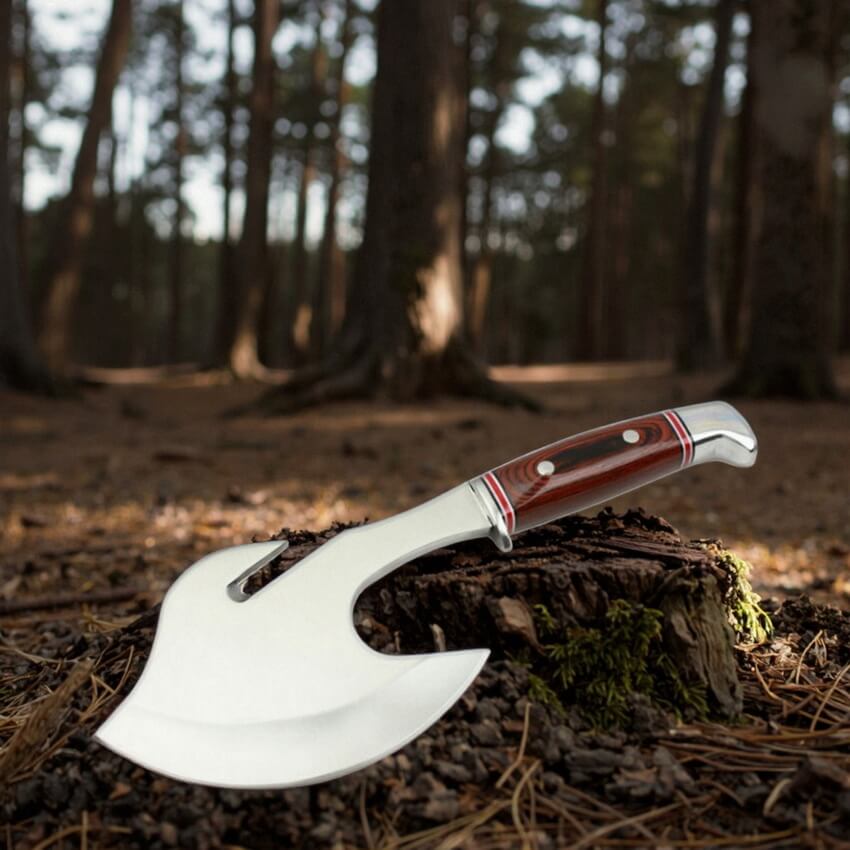
Ⅱ. Categories and Sub-Uses of Outdoor Axes
Based on size, weight, blade shape, and functional positioning, outdoor axes can be divided into multiple categories to cover all scenarios from casual camping to professional outdoor work, precisely adapting to different outdoor tasks:
1. Miniature Camping Hand Axe (Portable Model)
Small in size and lightweight, with a total length generally under 30 cm, it can be directly stored in a backpack. It is a must-have tool for casual camping. The blade is thin and sharp, focusing on lightweight operations. Its core functions include chopping small logs, trimming firewood materials, clearing small branches, and cutting simple camping accessories. Some models have a blade on the back that can be used as a small hammer for fixing tent stakes. It is suitable for short-distance camping, hiking, and picnics, being friendly to beginners and safe to operate.
2. Standard Camping Axe (Universal Model)
The most versatile outdoor model, with a moderate size and weight, balancing portability and operational capabilities. The blade has been optimized and the weight is well-balanced. It is easy to apply force. It can complete various tasks such as splitting thick logs, cutting small branches, clearing surrounding debris, and cutting simple camping accessories. It can also handle simple wood trimming, feather stick cutting, and other fine operations. It combines practicality and multi-functionality, suitable for most self-driving camping and outdoor leisure scenarios.
3. Forestry Chopping Axe (Heavy Model)
Designed for high-intensity woodwork, the axe body is thick, the handle is long, and the weight is sufficient. The chopping impact is extremely strong. The blade is mostly V-shaped, with excellent penetration power, capable of easily chopping small trees and splitting hard logs. It is suitable for large-scale clearing of forest areas, handling a large amount of firewood, and clearing forest land. The disadvantage is its large size and high weight, resulting in poor portability. It is only suitable for fixed campsites, vehicle-mounted outdoor activities, or professional forestry work.
4. Wilderness Survival Axe (Multi-functional Professional Model)
Focusing on emergency situations in the wilderness and multi-scenario adaptability, it is mostly made of alloy steel and forged as a single piece. It has powerful performance. The blade is sharp and precise, capable of performing fine cutting, peeling, chopping, and can be used as a hammer for breaking bottles, marking scales, and having a non-slip surface. Some models come with bottle openers, measuring tapes, and anti-slip hammer surfaces. It is resistant to impact and corrosion, able to adapt to extreme outdoor environments such as rain, cold, and humidity. It is suitable for wilderness exploration, long-distance outdoor activities, and emergency situations, and is the preferred choice for experienced outdoor enthusiasts.
5. Craft Repair Axe (Fine Model)
Different from chopping axes, it focuses on fine operations. The blade is sharp and fine, with precise angles. The blade shape is mostly flat and straight. It is mainly used for outdoor handicrafts, wood trimming, wood material grinding when building shelters, and cutting feathers for fire-making, as well as for cutting firewood sticks and kindling. It is suitable for enthusiasts who value outdoor handicraft experiences and Bushcraft outdoor skills.
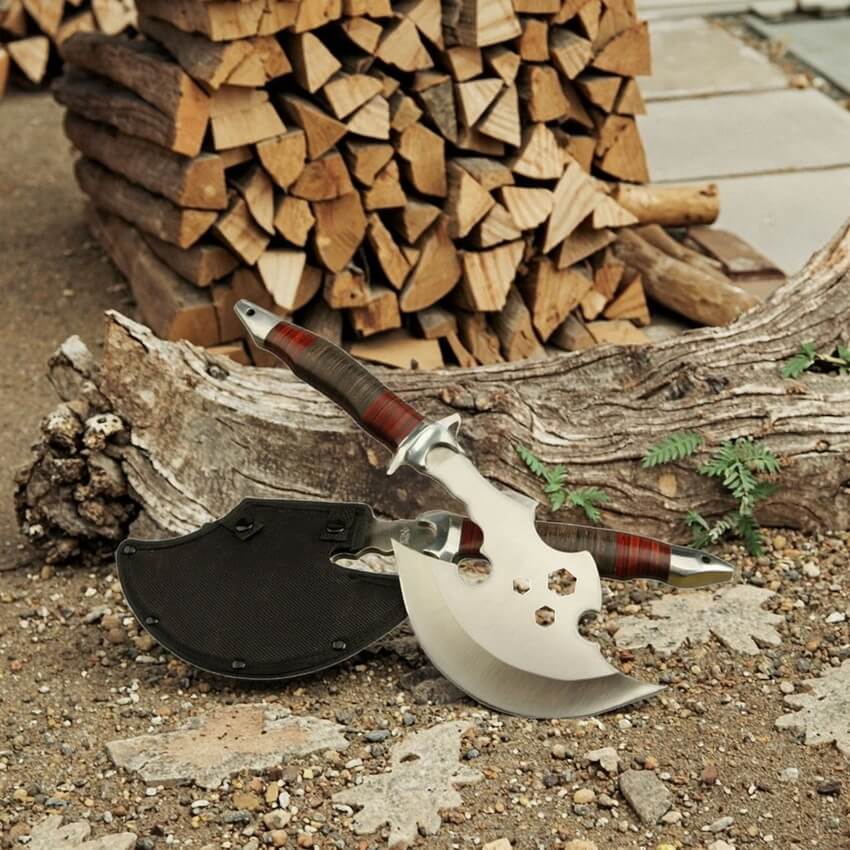
Ⅲ. Key Points for Selecting and Using Outdoor Axes
1. Core Principles for Selection
For short-distance casual camping and seeking portability and maintenance-free, choose the mini hand axe made of stainless steel and synthetic handle; For general all-purpose outdoor use, the preferred standard camping axe made of high-carbon steel and wooden handle offers a balance between comfort and performance. For professional use in the wild, high-strength operations, and extreme environments, the alloy one-piece survival axe is the best choice. At the same time, depending on the operation requirements, select the blade type. The V-shaped blade is suitable for rough chopping and felling trees, while the U-shaped blade is suitable for fine trimming.
2. Usage and Maintenance Tips
When using, avoid violent chopping of hard objects such as stones and metals to prevent the blade edge from cracking; for wooden-handled axes, regular application of wood wax oil is necessary to prevent sun exposure and soaking in water, which could cause cracking and deformation; for carbon steel axes, wipe off water stains and apply anti-rust oil promptly after use, and store them in a dry environment; stainless steel axes do not require frequent maintenance and can be simply wiped and dusted for storage over a long period. During outdoor operations, wear protective gloves, hold the axe properly, and exert force correctly to avoid accidental injuries and ensure safety during outdoor activities.
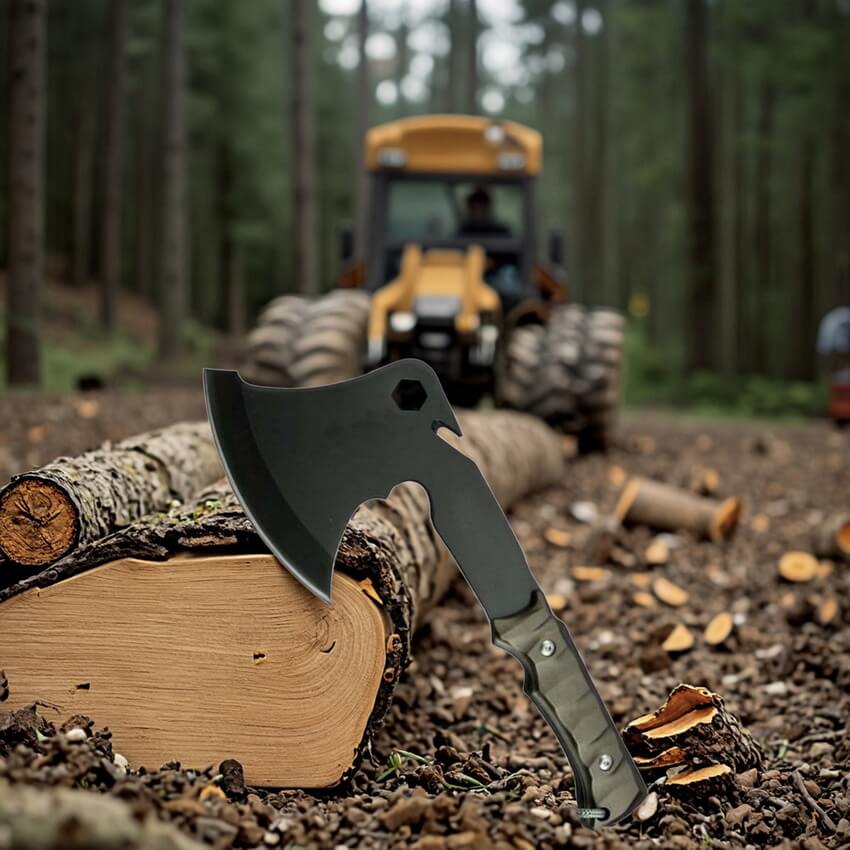
Ⅳ. Summary
There is no absolute superiority or inferiority for outdoor axes; it all depends on the suitability for the scenario. For lightweight and leisure scenarios, a portable and rust-resistant stainless steel composite handle axe is sufficient to meet the needs; for general all-purpose outdoor use, the high-carbon steel wooden-handled axe offers the best cost-effectiveness and experience; for professional and extreme outdoor use, the alloy one-piece survival axe has unparalleled comprehensive performance. By understanding the material characteristics and category usage, and choosing the right type based on your own outdoor scenario, and combining with the correct usage and maintenance methods, you can ensure that an outdoor axe can function stably for a long time and become a reliable helper for outdoor travel.


YJ GIS Industrial Limited

Windy

+ 86-13751611669


R-403, Block 14,Lakeside Villa, XinJiang Bei Rd, YangJiang, GuangDong, China. 529500


 + 86-13751611669
 + 86-13751611669
 windy.zhong
 windy@goldinsea.cn
